Guide section
Why Nurses Can Have an Ownership Advantage
Nurses often bring stable income, discipline, and people skills that can translate into better real estate decision-making.
Nursing teaches consistency, documentation, pressure management, and communication. Those same habits matter in real estate, especially when evaluating tenants, contractors, lenders, sellers, and timelines.
The opportunity is not that real estate is easy. The opportunity is that nurses may already have several habits that help ownership work: showing up, following process, asking questions, and staying calm when details matter.
Guide section
Start With Financial Readiness
The first step is understanding how much cash, credit, debt, reserves, and monthly comfort you can realistically bring to a deal.
Before looking at properties, clarify your financial position. That includes credit, debt-to-income ratio, savings, reserves, current housing cost, available down payment, and comfort with unexpected repairs.
A lender can help define what may be possible, but the owner has to define what is responsible. A preapproval number is not the same as a safe monthly payment.
- Know your monthly budget before touring properties.
- Keep reserves separate from down payment.
- Ask how overtime, shift differential, or variable pay is treated by lenders.
- Understand how student loans or other debt affect approval.
- Avoid using all available cash just to close.
Guide section
Create a Buy Box That Fits Your Schedule
A nurse's buy box should consider work schedule, commute, repair tolerance, tenant plan, and backup support.
A strong property on paper can be a bad fit for someone working long shifts. The buy box should match your life, not only your ambition.
Decide what you can realistically manage. A low-maintenance house hack near work may be a better first step than a heavy rehab across town.
| Buy box factor | Practical question | Risk if ignored |
|---|---|---|
| Location | Can you reach work, property, and vendors easily? | Time stress and delayed maintenance. |
| Condition | Can you handle the repair level? | Unexpected cost and contractor dependence. |
| Tenant plan | Who lives there and how is rent collected? | Vacancy or conflict. |
| Support | Who helps when you are on shift? | Slow response during urgent issues. |
Guide section
House Hacking Can Be a Practical First Step
House hacking lets a nurse live in the property while using other units or rooms to offset housing cost, if the numbers and rules support it.
A house hack can mean a duplex, a single-family home with rented rooms, or a property with an accessory unit. The structure should match local rules, lender requirements, privacy needs, and your comfort level.
The analysis should include your housing cost after rent, repairs, utilities, vacancy, insurance, and reserves. The goal is not to force a property to work. The goal is to find out if it works under realistic conditions.
- 1
Confirm owner-occupant rules
Understand lender occupancy requirements before planning the rental strategy.
- 2
Verify local rental rules
Check room rental, accessory dwelling unit, licensing, and occupancy rules.
- 3
Model your actual payment
Use principal, interest, taxes, insurance, utilities, repairs, and reserves.
- 4
Protect your schedule
Have maintenance support and resident communication systems before move-in.
Guide section
Build a Team Before You Need One
Nurses moving into ownership need reliable professionals before the deal becomes urgent.
A good team does not remove responsibility, but it reduces guessing. At minimum, build relationships with a lender, agent, insurance contact, contractor, inspector, and property manager or maintenance support.
Ask each person practical questions. What do they need from you? How fast can they respond? What deals do they think are not a good fit for a first-time owner?
Guide section
Choose the Ownership Path That Matches Your Risk
The right first step may be a house hack, small rental, partnership, or education path before buying.
Not every nurse should buy immediately. Sometimes the best next step is running numbers, learning the process, improving reserves, paying down debt, or shadowing deal analysis inside a community.
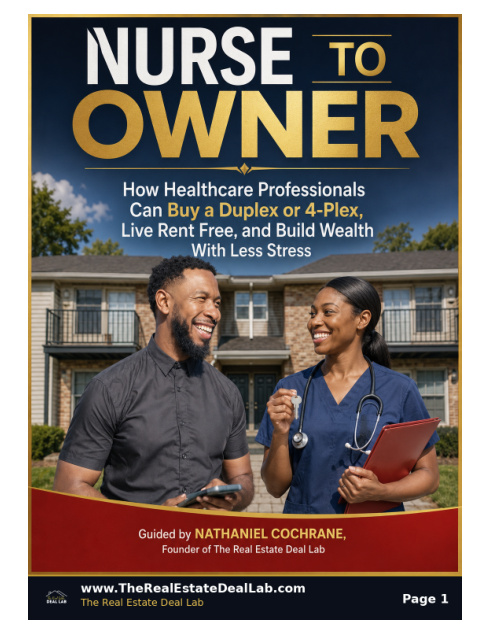
Ownership works best when the decision fits your numbers, schedule, risk tolerance, and support system. That is the point of the Nurse to Owner path.
FAQ
Questions this guide answers
Sources and trust
Educational sources and disclosures
This guide is educational content from The Real Estate Deal Lab. It is not financial, legal, tax, lending, or investment advice. Use qualified professionals before making decisions that affect contracts, financing, taxes, insurance, or legal structure.